Music Its Role and Importance in Our Lives Chapter 19 Review Answers
I dearest educational activity. One of the things I love most about teaching is that I always learn something new, both from my preparation and from the participants in the class.
This is uncommonly truthful for my most recent class, The Story of the Story: History, Art, and Culture of the Haggadah. We have discovered so many interesting tidbits equally we accept a journeying aslope the evolution of this "book" – a text that continues to modify.
In 2011, Edward Rothstein wrote in a New York Times article that over 5,000 editions of the Haggadah had been published since the invention of the press press. Considering that 5,000 doesn't include the many illuminated manuscripts created in the Middle Ages nor does it include the vast number of editions that take been published in the past ten+ years, I can't even imagine what the real number is. And with the explosion of online and DIY Haggadot… the number is incalculable.
Why and then many editions? The liturgy in the Haggadah is not exactly mandated or required. The master goal is to tell the story, to relive the Exodus, to celebrate our freedom and commit to working toward the liberty of all people.
The "traditional" text of the Haggadah wasn't fully in place until the tardily Middle Ages. Although some basics were outlined in the Talmud, there was no book or instructions. In the early on Rabbinic period, they held a study session instead of telling the story of the Exodus, and they were forbidden for taking role in the Afikomen. What? No searching for the Afikomen? In those times, as the Passover Seder was modeled subsequently Greco-Roman banquets, "afikomen" or "dessert" referred to the post-dinner revelry that we should nearly definitely non participate in. Parents were encouraged to create a game of matzah snatching to keep the children engaged; perhaps that was the precursor to the Afikomen search.
Some tidbits we have discovered is that the order of the Passover Seder wasn't written downward until the 12th century; that Maimonides wrote the passage Ha Lachma Anya – the "bread of affliction; and the Seder Plate itself didn't make an appearance until the sixteenthursday century.
The about interesting to me – then far – was a question asked and later answered (through some research) by a form participant about a play a joke on seen in an illuminated manuscript. It turns out that many illuminated manuscripts include the motif of a rabbit or a hare beingness chased by dogs or hunters or even a fox. In every prototype, the hare escapes. Why is this non-kosher animal in our Haggadah? Information technology could exist that the hare was a common paradigm for the time. But in the context of the Haggadah, the hare symbolizes the Jewish people being persecuted and surviving time and time again. From 1 odd epitome almost hidden in Haggadah illustrations, we find the principal theme of Passover symbolically represented: freedom.
At that place'due south then much to learn, and then many creative ways to explore our by, our present and our future in this holiest of days.
Chag Sameach – Happy Passover (about)
It'south difficult to believe that 5 weeks ago, Russian federation invaded Ukraine in their entrada to take over the country. The ongoing "breaking news" flashing on our TVs and on social media describes the latest on the devastation that Russia is bringing to Ukraine and the escalating humanitarian crisis. It is hard to scout, to mind to, or to read well-nigh, but we can't hibernate away.
This war affects us all – in the nowadays and in the time to come. Not just in inflated gas, wheat and other food prices, or through the influx of Ukrainian immigrants to the U.South., or in our heartbreak for human beings needlessly suffering. The state of war is not only most Ukraine; information technology is well-nigh all of us.
Our Jewish values demand that we reach out to care for Ukraine and her citizens and to help those countries who are overwhelmed with profitable over 4 1000000 refugees who accept left Ukraine. Many of us take helped in different ways: we accept contributed money to relief efforts, contacted our representatives, featured the bluish and yellow colors of the Ukrainian flag in a diverseness of media to evidence back up. And yet we ask: What can nosotros do ?
We tin can look back through Jewish history and heritage and see our people's ties to Ukraine. Some of us tin can look to our own family history for the aforementioned link. At Temple Emanuel Sinai, we have young man congregants who were built-in in Ukraine and made their mode to the Us much more than recently. What can we do ? We can achieve out to them particularly, show our care and support, enquire how they are doing and ask about family and friends directly impacted. So we tin can ask them our question: What can we do ? What should we do ?
Tatyana and Jacob Gorodetsky grew up in Ukraine and came to the U.s.a. in the early on 1990's via Belarus. Their family unit has been office of our TES community for many years. They welcome your questions and have some concrete ideas on how we can all aid. Feel free to contact Tatyana through email: tghm1155@gmail.com.
I often find it meaningful for prayer to be the last words that linger with us – on our lips, in our ears, on our hearts and minds. These lines from "A Prayer for Peace in the Ukraine" by Rabbi Sabath Beit-Halachmi articulate what I've been feeling and what I imagine many of usa take been feeling.
…Nosotros stand up together with our brothers and sisters in the Ukraine,
the birthplace of then many of our ancestors,
a place where the Jewish people has known both calorie-free and darkness.
We pray for a quick terminate to the raging conflict and the senseless bloodshed.
May our people remember that wherever a Jew is in danger or injure,
nosotros all experience that danger and pain too.
Equally they seek comprehend from the life-threatening missiles
and fire falling from the sky, every bit they help the elderly
and hug their children tightly, and defend their homeland,
nosotros pray that they can maintain hope that a Sukkat Shalom–
a awning of blessing and peace–
will soon emerge above them.
May all the innocent people in the Ukraine and throughout the region
know that we are with them. Fifty-fifty from afar, we hear their cries.
May they know that we volition proceed to advocate for peace among nations
and that nosotros will strengthen our commitment to aid and protect
every human beingness…"
Amen.
Assistance. Thanks. Wow.
In the book Help, Thank you, Wow: The Three Essential Prayers, author Anne Lamont brings prayer to its most basic meaning and makes it accessible to all.
Help, Thanks, and Wow are the themes of all Jewish prayers whether expressed lone in personal prayer or as part of a structured worship service.
Today, I want to focus on Thank you – gratitude.
In add-on to being office of our liturgy, gratitude is of import considering it puts everything in perspective. Giving thanks reminds the states of our blessings and all that is good in our lives. A gratitude practice – articulating what we are grateful for on a regular basis – can lift our spirits and bring u.s.a. joy. Enquiry shows that regular acts of gratitude can fifty-fifty meliorate our concrete and emotional health.
Through many of the blessings in our worship service, nosotros accept the opportunity for a regular gratitude practice. Of those blessings is unique as it combines an private blessing with a congregational affidavit. In our Torah service, right after our prayer for healing, it is customary to say a thanksgiving blessing, called the Birkat haGomeil. Traditionally, this prayer is said by individuals who have survived life-challenging situations, for example: recovering from an illness, returning safely from travel, and overcoming a tragedy.
Even though Birkat haGomeil doesn't traditional extend to other things we may be grateful for, like a simcha (happy effect), or appreciation of nature, or the kind act of another human being to name a few, the wording of the text can utilize to whatsoever reason for gratitude.
The text of Birkat haGomeil invites an individual to recite in front of the entire customs: "Blessed are Yous, Adonai our God, Sovereign of the universe, who has bestowed every goodness upon united states of america." And then the congregation responds, "Amen. May the I who has bestowed goodness upon us continue to bestow every goodness upon u.s.a. forever." (Translation from Mishkan T'filah)
The unique nature of Birkat haGomeil is that it brings our gratitude to the public, and lets the congregation know what good things are happening in our lives. Then all of united states of america can be grateful for each other's blessings every bit a community.
This Shabbat, nosotros're going to begin this custom of inviting participants to share something they are grateful for in a short sentence. Nosotros'll take alphabetize cards for you to write on before the service and there will be an opportunity to share out loud for those who are comfy doing so. Nosotros hope to invite our online worshippers to participate once we determine the best method for that communication.
Even in our turbulent world, we take and so much to be grateful for. Let united states share our blessings with each other so we tin can rejoice together. Amen.
I wrote my rabbinic thesis on the magic and demonology found in a thirteenth century book called Sefer Hasidim, The Book of the Pious. One of my favorite stories from the text describes how to miscarry demons from a space where you want to build a house. 10 men, one of whom carried a Torah scroll, were required to walk a grid over the space so they covered every inch of footing while reciting psalms. Other instructions designated how to consecrate a new home with a diversity of rituals involving salt and staff of life. It is a wacky book.
This may sound like a wacky ritual from a wacky book, only the principal remains relevant today. These Jewish men wanted to ritually cleanse a space and so they could build a firm. They needed to purify information technology in order to create a holy space. I'd like to think we don't accept or believe in literal demons today; perhaps our "demons" are bad memories or negative feelings tied to a space. So, creating an emotionally safe infinite today is equally of import – whether at home, at work, at schoolhouse, at temple or other special places. Simply like hundreds of years ago, we can blueprint means to remove negative feelings and memories from a infinite and infuse information technology with positivity.
Our Torah portion this week, Tzav, addresses the same concept, although it is a brief comment that could be hands overlooked. In chapter 8 of Leviticus, during a give-and-take of the priests' ordination, one verse describes how Moses uses parts from the animal sacrifice to "purify the modify" and "consecrate it." Why were both purify and consecrate mentioned? Aren't they the same thing? When I looked at the Hebrew, I realized they had different purposes. Consecrate is like shooting fish in a barrel: the Hebrew word vay'kadesheihu means to make holy. Only the Hebrew words for purify, vay'chatei comes from the same root as sin, which can besides exist translation as expiation or even redemption. In Biblical times, when a sin offering was made, it was to repair or redeem the error that was made; from a ritual perspective information technology was well-nigh as if the fault was taken away with the sacrifice.
Perchance the Hebrew vay'chatei tin teach us that when we want to purify a space, we need to perform a ritual to take away any bad memories or feelings that we might associate with the identify. If every time we walk into a certain place, we relive a bad retentiveness, that infinite volition never feel good or safe. To make a place holy, we need to repair the space. What a concept! I don't necessarily accept a ritual to offer for the purification; I recollect it depends on you, your memory, and what you demand. It's in our ability to transform spaces into something holy.
Last Shabbat after the Torah reading, when we chanted the words, "chazak, chazak, v'nitchazeik" – be strong, be strong, and let u.s.a. be strengthened – I wasn't thinking about the fact that nosotros would begin the volume of Leviticus this week.
Leviticus is not my favorite book of the Torah. Outside of the Holiness Code (Chapter 19), and mayhap a few other sections, I don't discover the material very interesting. I tin't seem to focus on the long descriptions most animal sacrifice and how the priests fulfilled their jobs. Every year, whether in sermons or Torah Study, I struggle to find ways the text is relevant to our lives.
This twelvemonth, my reflections on my struggles with the book of Leviticus brought me a couple of insights – or reminders of why the content of Leviticus is valuable.
I may consider animal cede and the role of the priesthood outdated, but their inclusion in our sacred text and the historical evidence of their centrality in Judaism shows that they were extremely valued. I may non value them, but someone did, and those "someones" are my ancestors. Reading the details well-nigh the priests' chore made me remember most a friend or a family member who recounts all the details of their task. We might discover the task and the description boring, only because we intendance almost them, and hopefully don't detect the person dull, nosotros care about what they have to say. For these reasons and more than, I can observe value in the text.
My second reason the text is valuable is because our worship structure is based on the sacrificial system. When the ancient rabbis realized that beast cede was non the merely way to worship God, and perhaps may not be available as a exercise at all, they adapted the sacrificial worship into a liturgical construction – prayers – that continues to exist the basis of our services today. Additionally, near of our ritual and ethical commandments are grounded in the text of the Torah, which of course includes the book of Leviticus. And the rabbis knew how hard Leviticus was, so they created some of the near inventive midrashim – explanations – based on Leviticus. I recollect studying a midrash based on Leviticus that was really all about Purim!
Then, as we begin the book of Leviticus this week, with a hint to the celebration of Purim that volition have place in the coming days (see below), I hope to accept my own communication and value the struggle with my least favorite notwithstanding however valuable sacred text.
Today is Rosh Chodesh Adar Ii. Traditionally, the month of Adar is the month in which joy should have over as our master emotion (Adar I and Adar Two in a leap year). It is difficult to feel joy when lookout human beings suffer. As nosotros pray for peace – in Ukraine and in the earth, nosotros pray and hope for a day when joy will not only exist easy simply the near common emotion of every human beingness. This poem, written past Miriam Klimova in Ukrainian and Hebrew followed by an English translation past Rabbi Lior Nevo and Aharon N. Varady, not only asks for protection for all who are in danger merely all expresses that hope for peace.
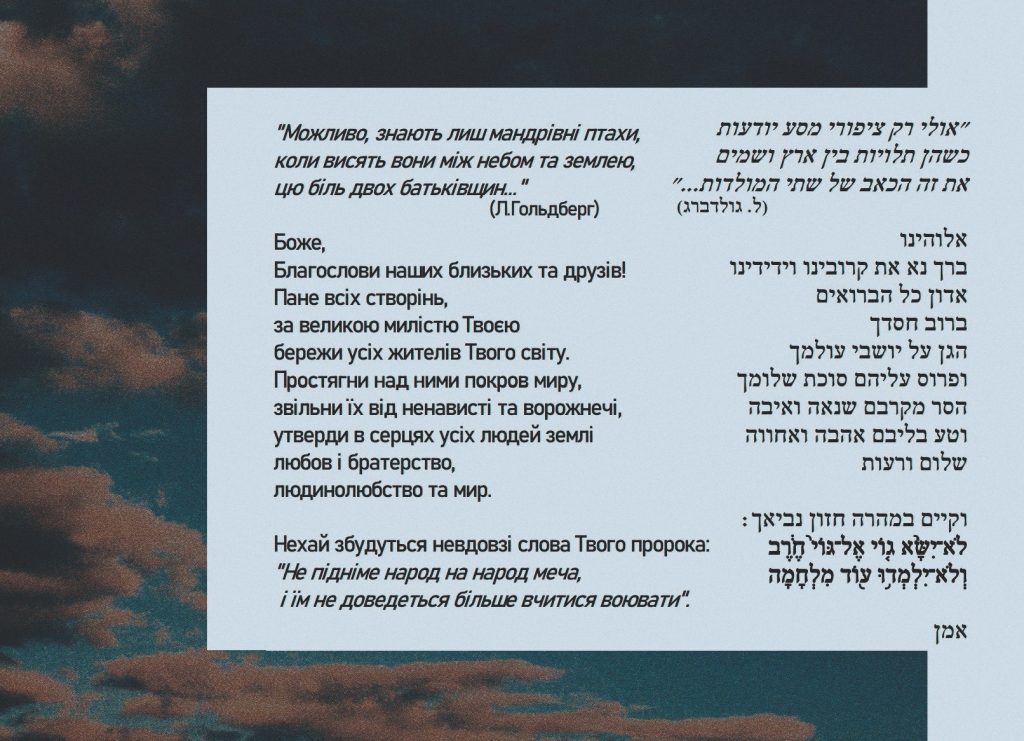
English Translation:
"Mayhap only migrating birds know –
Suspended betwixt world and heaven –
The heartache of 2 homelands…" (From "Pine" (1955) by Leah Goldberg)
Our God,
anoint our friends and relatives!
Lord of all creatures,
by your great mercy,
protect all the inhabitants of your world.
Spread over them a canopy of peace,
liberate them from all hatred and enmity,
and plant in the hearts of all people of this globe
dear and fraternity,
friendship and peace.
And fulfill the vision of your prophet:
"Nation will non take up sword against nation,
nor volition they train for war anymore." (Isaiah 2:4)
Amen.
This week's Torah portion, Ki Tisa, includes the story of the Golden Calf. This story is familiar even for many who would not consider themselves knowledgeable in the Bible. Moses was on the mountain talking to God for a really long time, and the Israelites became impatient. Perhaps he'll never come back? They lost their religion in Moses, in this new God they couldn't see, and they built an idol – a "god" they could come across.
Yesterday, at a worship committee meeting, I asked our members why the Israelites built the Golden Calf. I wanted to dig deeper than the usual reasons listed above. Nosotros talked about the trauma the Israelites had experienced: years of slavery and now all of a sudden beingness free. They didn't know where they were going, what was happening, what the future would hold. They were wandering, lost – physically, emotionally, and spiritually. The i person who held a hint to the answer of these mysteries was gone. He had disappeared, and there was no discussion when or if he would return.
They needed to do something. And so they return to the familiar, to their comfort zone even if they know in their hearts that no positive effect will result from their actions. After all, this Golden Calf, a symbol of Egypt, is nigh like a memorial to their by enslavement. But they can't seem to help themselves.
Nosotros, too, are a niggling lost. We yearn for answers: what does the future expect similar? Many of us hold on to our condolement coping methods, even when nosotros know that they're not and then helpful: Oh chocolate, how lovely do you make me experience! We recollect about "going back to normal" when there's no such thing every bit "going dorsum" or "normal". Only nosotros can't seem to assist ourselves.
When Moses finally comes down the mount, he offers guidance for the future: the innovation of the 10 Commandments, and some say the Torah. Yes, information technology's a new path, unfamiliar and scary. But what he – and God – take provided is a way to heal by going forward.
Nosotros, besides, will find a new path to comprehend, even if it is unfamiliar and scary. Information technology will have characteristics of the past, like spending time together and in person, and seeing the grinning faces of other people. It won't exist the same, and information technology will be the way we heal forward.
Some of you may have heard most Whoopi Goldberg's comment on the television talk show "The View" regarding the Holocaust not being about race. The response to her comment was swift, stiff, and varied. Some people were incredibly harsh, accusing her of existence Anti-Semitic, while others were interested in determining if her stance was from lack of understanding and education. The very next day, later on speaking to a number of Jewish leaders and educators, Whoopi issued an apology on "The Voice" and on social media. She apologized for the hurt she had acquired, acknowledged her wrongdoing, and exhibited a willingness to listen and larn.
A friend sent me an opinion piece today about ABC'south decision to suspend Whoopi Goldberg from "The View" for two weeks fifty-fifty afterwards her apology. The writer of the article explained that Whoopi's apology was in line with our Jewish values of t'shuvah (repentance), and information technology would be better to go on the conversation in the public so others could larn too. Nosotros should accolade people when they realize their mistakes, learn from them, and brainstorm to repair the damage. In fact, for someone who sincerely and correctly does t'shuvah, Judaism considers it a double mitzvah.
In thinking about ABC's reaction, the vitriol Whoopi Goldberg received, the ascension Anti-Semitic words and deportment in our state, and so many challenges in other topics that are besides depressing to name, I experience like nigh of us are feeling "on the edge". We are unsettled, burned out, quick to react with anger or annoyance instead of empathy and compassion. This land of beingness is understandable, nevertheless non helpful to ourselves or others.
Yesterday, I met with our seventh course Religious School grade as they finished preparing for leading Shabbat Services tomorrow nighttime (for our early service, six:30 pm, on zoom and live-streamed). My brusque time with them reminded me how wise our young people are, from our littlest ones to our teenagers. The 7thursday graders wrote personal prayers to fill up in what they felt were gaps in our prayer book: prayers that expressed compassion for ourselves and others. They felt that this was something we needed to talk and pray about especially now.
They are absolutely correct. If everyone'southward default was compassion – especially in challenging times, can you imagine how different people would exist? I'm non sure I tin cover a world ruled by compassion – it's beyond my feel. Merely I tin can imagine working on my instinct toward compassion, and I tin can imagine beingness surrounded by a group of people who are compassionate. We brand a difference i person at a fourth dimension in order to modify the world.
Our viith graders take begun the process. Come to services tomorrow night to be inspired and join with them to increase pity in our earth.
In Mussar literature every bit well every bit in parenting, we are taught the concept: "midah thousand'neged midah". This can exist loosely translated equally "measure for measure." In parenting, we effort to make sure that we are responding appropriately to our children at the same level, or "measure" equally they are behaving, whether answering their questions or consequences for breaking a dominion. We're probably most comfortable applying this concept to the latter, or in more obviously language, making sure the punishment fits the crime.
Even in Judaism, the idea of "measure for measure" has that connotation. We clarify the Torah and the reward/punishments attributed to post-obit the mitzvot according to that standard and sometimes even approximate God's behavior that way besides.
Mussar, which started developing in the Centre Ages, is a Jewish spiritual practice that gives physical instructions on how to live a meaningful and ethical life. Musar literature has a dissimilar view of "midah yard'neged midah". Mussar understands midah as a characteristic, and each feature tin can be taken to extremes on either side of a spectrum. Our goal is to find the correct balance for us.
Mussar, spiritual exercise, and near of all balance all came to mind when I read an article from the Harvard Business organization Review titled, "Your Burnout is Unique, Your Recovery Will Exist Too." I was directed to this article from a clergy arrangement talking about organizational burnout, and how organizational burnout is rooted in private burnout. We tin can't solve burnout at an organizational level because each person'due south burnout is unique; it must exist solved at the individual level.
The article identified 3 kinds of burnout and specific actions that tin can exist used to "residual" each kind to aid mitigate the negative effects. If we have a item kind of burn-out, and yet try an action that is better aimed toward a different kind of burn-out, and then the activeness may fifty-fifty backfire. For case, taking extra fourth dimension off and practicing self-intendance is not the solution to everyone's burn-out. It's hard to imagine, simply for some who may exist feeling lonely from lack of human being contact, having more focus on themselves isn't necessarily helpful.
I encourage all of us to read this article for 2 reasons: I expect that in some manner everyone is feeling fire-out or trauma from the changes in our society, and I believe this commodity is helpful. The article also reminds united states of america that nosotros're all different and we all demand different things.
"Midah K'neged Midah" – Measure for Measure
The need for residuum, though, is certainly ane thing that nosotros all have in mutual.
Last Shabbat, I spent the morning moving my son Gabriel into his dormitory at Clark University. I know, not a typical Shabbat morning activity for a Rabbi; but when your child's college sets the motion-in time, a parent is non going to argue.
I returned home, common cold and exhausted, trying to warm up and relax. Not long after I got home, I received a text and a phone telephone call almost simultaneously from two different friends: "Plough on CNN" and "Are you sitting down? I need to brand sure you know something…" They were talking about the hostage situation at Congregation Beth State of israel in Colleyville, Texas. It was frightening and horrifying, and finally, after 11 hours of being held at gunpoint, Rabbi Charlie Cytron-Walker helped the other hostages escape. That's the short version.
I told my husband Jonathan that Colleyville was my second worst nightmare.
Now, nearly a week afterwards, many of us are all the same processing what happened to these 4 hostages. What will now forever exist a part of history to the small, once unknown Jewish community of Colleyville, and to our global Jewish community. It has echoes of too many other recent attacks: Tree of Life in Pittsburg; Chabad in Poway, CA; a Kosher supermarket in Jersey City; and then many more. With the image of the white supremacists marching in Charlottesville there besides.
I imagine each of united states is responding differently to the events of terminal Shabbat – how could nosotros not? There are so many layers to what happened, to our own histories and personal traumas, to the communal trauma nosotros go along to live in, and to how much our hearts and heads can handle.
Some of usa may be numb or fifty-fifty desensitized; later all, gun violence is so commonplace.
Some of us may be aroused and horrified because gun violence is so commonplace.
Some of us may exist reliving all the anti-Semitic events of our past, or information technology has triggered other personal traumas.
Some of us may be grateful that they survived, and proud of Rabbi Charlie's actions.
Some of us may be then tired and exhausted, we don't know how to describe our feelings even if we try to.
Some of us may exist scared to become to temple.
Some of us may be demanding that we never unlock our doors once more to protect our members, following the Jewish value of saving lives.
Some of us may be emphasizing the Jewish value of welcoming the stranger, reminding the states that this essential value cannot be compromised, considering so who are nosotros?
Some of u.s.a. may be thinking well-nigh the reports of escalating Anti-Semitic incidents, and in fright for ourselves and our people.
Some of us may take heard the story, been relieved that no one died, and then moved on to respond to how our life is calling out to us.
For some of us, this feels surprisingly personal.
The "Some of us…" statements could continue and on.
A colleague and mentor of mine referred to this equally "The Swirl".
At times like these, the Jewish customs has always responded by gathering in prayer. Nosotros need each other, the "some of us" becoming all of us, equally nosotros piece of work toward healing, sharing gratitude that the story ended in survival, praying for a futurity without and so much hate, and starting to think nigh the activity that will get us there. Nosotros may be online for services, just we are still together.
Entering Shabbat: A Fourth dimension for Healing and Gratitude – please join special guest Cantor Rosalie Will and Rabbi Valerie Cohen for a musical Shabbat Service. Equally we leave the calendar week backside us, we exercise what Jews e'er do after trauma, whether personal or communal: we get together in prayer. Through our shared presence, with open hearts, and led by music that is both new and familiar and always inspiring, nosotros will set up aside this time – making it holy – for healing and gratitude.
Post-obit services, we will assemble on Zoom for our Shabbat Schmooze, where there volition be an opportunity for people to share how we are feeling as we reverberate on the hostage situation that took place last Shabbat at Congregation Beth State of israel in Colleyville, Texas.
Source: https://emanuelsinai.org/author/sean/
0 Response to "Music Its Role and Importance in Our Lives Chapter 19 Review Answers"
Post a Comment